Showing posts with label Macdonald Carey. Show all posts

The Lawless (1950) - Film Locations

The Lawless (1950)

In something a little different today, I've gone beyond my Los Angeles borders to track down film locations in two Northern California towns seen in the 1950 Joseph Losey movie, The Lawless. Many of Losey's films analyzed different social issues and in The Lawless, the director shines a light on racism in a small California community. What shocked me when I first saw this film is how contemporary it feels sixty-one years later.

The friction is between the middle class whites that live in the fictional town of Santa Marta and the Mexican fruit pickers that live in the poorer neighboring community, Sleepy Hollow. Not all, but many of the residents in the white community look down at the Mexican immigrants, considering them lazy and troublesome. During one evening, some white teenagers decide to go to Sleepy Hollow for a night of dancing. At the dance, the white teenagers pick a fight and an all out brawl ensues, spiraling out of control. When one of the Latino boys accidentally hits a cop many people in the white community, without knowing all the facts, go on a hunt for the Mexican juvenile, much like the mob in the Fritz Lang film, Fury.

Macdonald Carey, a regular in many 'B' movies, plays Larry Wilder, a newspaper publisher who has left the city life to go live and work in a quieter small town similar to the one he fondly remembers growing up in.  Being new in town, Carey initially doesn't want to make any more waves in the community than there already are. When Carey realizes just how bad the anti-Mexican hatred is he decides to take action, using his newspaper to get out the facts and to be a voice of reason in the community.

Macdonald Carey outside The Union Square Building

Union Square Building, 151 Mill St, Grass Valley, Ca

Above and directly below are screenshots from the film showing Carey's newspaper office building compared with contemporary images of the location. In the film, this building was to be in the fictional town of Santa Marta, but this building is located at 151 Mill Street, in Grass Valley, California. What I think is interesting is that this building, built in 1864, really was a newspaper building according to the Nevada County Association of Realtors website.

Another view of Union Square Building from The Lawless

151 Mill Street, Grass Valley, Ca - Union Square Building

The next few screen comparisons show more locations moving down Mill Street in Grass Valley, going in the direction of the historic Del Oro Theatre. You will see the residents beginning to form a mob and then turning into a chase scene.

Mexicans driving down Mill Street through the white crowd.

Cars driving down Mill Street near the Del Oro Theatre.

The Del Oro Theatre in the background as seen in The Lawless.

Del Oro Theatre, 165 Mill Street, Grass Valley, Ca

According to Cinema Treasures, the Del Oro Theatre was built in 1942, making the theatre only about seven years old during the time The Lawless was being filmed.
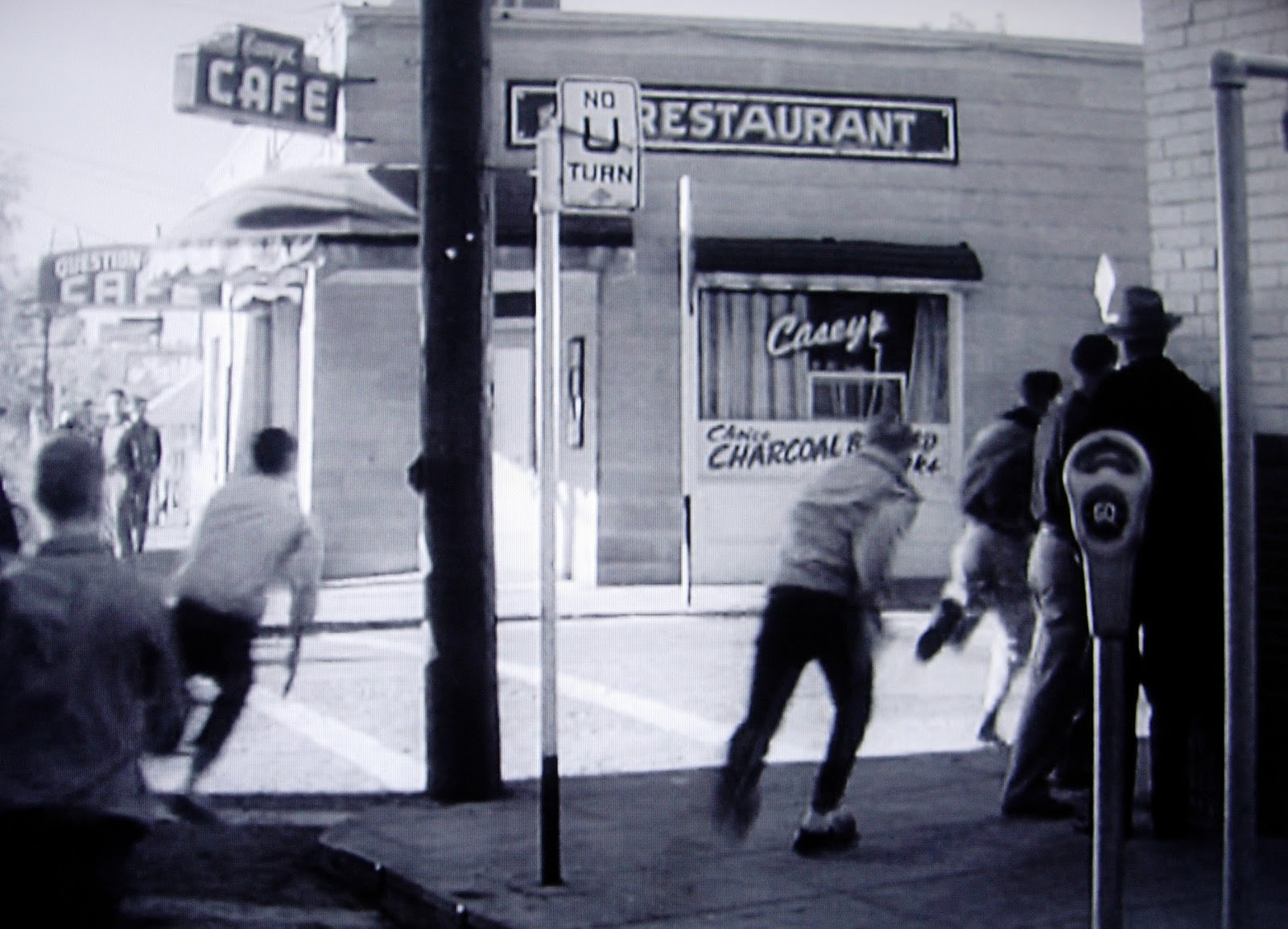
The mob races past Casey's Restaurant in Grass Valley.

Casey's Restaurant is now a parking lot.

In the above scene, the crowd formed into a mob and began racing down Mill Street, chasing one of the Mexicans past Casey's restaurant at the intersection of Mill and Neal Streets. As you can see, Casey's Restaurant is now a parking lot.

In the next screenshot comparisons, what is supposed to still be Santa Marta was actually filmed in Marysville, California, about 30 miles away from Grass Valley where the other scenes were filmed.

5th Street at D Street, Marysville, Ca as seen in The Lawless

Looking down D Street at 5th Street, Marysville, Ca

In the screenshot above, if you look in the upper right corner, you can see the pointed circular peak of what was the Western Hotel. I was able to identify this building thanks to some historic images on the Historic Downtown Marysville website. You can check out this informative and interesting site by clicking here. The Historic Downtown Marysville site says this about the hotel:

"Opened on November 1, 1853, the five-star Western Hotel was built for $30,000 by R.J. Murray. It burned in May 1854,  June 1933, and August 1956 [just seven years after The Lawless was filmed]. The hotel had installed the first elevator, steam heaters, and electricity between Sacramento and Portland in 1911; thus, it kept the hotel ranked with its five-star rating. The hotel stood for 95 years and was demolished in 1956."

As you can see, the hotel is not the only building missing since the time of filming. Clearly some of the other buildings that once stood on D Street are now gone.

The next couple comparisons show the old Yuba County Court House in Marysville, which was located at the corner of 6th and D Streets. Like the hotel, the old Court House is no longer standing.

Yuba County Court House as seen in The Lawless.

6th & D Streets, Marysville, Ca - Former site of Court House.

In front of the Court House, looking down D Street.

Looking down D Street where the Court House once stood.

In the next scene comparison we see a park in the center of town that the mob passes through during the chase scene. This park was Cortez Square, located near where the Court House used to stand. The park was situated between B and C Street and 5th and 6th Street. Like the Court House, Cortez Square is also gone.

Cortez Square, Marysville, Ca as seen in The Lawless.

Cortez Sqaure now covered by buildings.

This last comparison shows Ellis Lake, located in Marysville, Ca. The lake can be seen later in the film when a cop drives by the sign reading "Santa Marta - The Friendly City."

A view of Ellis Lake, in Marysville, Ca.

A present day view of Ellis Lake in Marysville, Ca.

The Lawless is an entertaining 'B' movie that has held up well over time. In addition to seeing real life film locations, another great thing about this movie is that Joseph Losey cast actual Latinos, rather than throwing on some dark make-up on white actors to play Latinos. I always grimace a bit when I see that done.

The Lawless is currently available for streaming on Netflix. I don't believe there has been any official studio release of The Lawless on DVD, but it can be found for sale online.

All present day images (c) 2013 Google; (c) 2013 Microsoft Coporation, (c) 2012 Pictometry International Corp (c) 2012 NAVTEQ.

Your thoughts?

Macdonald Carey Childhood Home

Macdonald Carey

For many, Macdonald Carey is best remembered as Dr. Tom Horton on NBC's soap opera Days of Our Lives, a role he had played for nearly three decades beginning with the shows inception in 1965. But before Carey became a fixture on daytime television he was a regular on radio and then later in Hollywood films. Some of his notable features include supporting parts or lead roles in Alfred Hitchcock's Shadow of a Doubt (1943), Suddenly It's Spring (1947) alongside Fred MacMurray and Paulette Goddard, Joseph Losey's The Lawless (1950), and Let's Make It Legal (1951) with Claudette Colbert.

Click images to see larger.

2711 Jones Street, Sioux City, Iowa

Carey's interest in films and performing started at an early age, back when he was growing up in Sioux City, Iowa. The family home was located at 2711 Jones Street, across the street from Hubbard Park. At the Jones Street home Carey had a theater in the parlor and then later in the basement where he would perform magic tricks and recitations. With a film projector given to him by his father, Carey would charge neighborhood kids ten or fifteen cents to watch Buster Keaton, Lloyd Hamilton, and Charlie Chaplin comedies that he had rented or purchased. When Carey wasn't performing or showing films he was interested in sports, playing pickup games of basketball, hockey, baseball and football with friends in the neighborhood.

Carey's childhood home. 2711 Jones Street

Carey's mother, a lover of the arts, encourages him to develop his musical talents. She has Carey take years of piano, violin, drum, and singing lessons. Carey writes in his autobiography, The Days of My Life:
"Besides all my music lessons, I am in the Boy Scouts, I take ballroom dancing and tap dancing, and, by the time I get to high school, I am playing drums in a little jazz combo. Every Saturday morning, I have French lessons from Professor Greynald. In the winter, I play hockey; each spring and fall, there is a constant basketball game in our backyard. Poor Grandfather complains in 1927 that the backyard is as white as the street. He should complain. We trample the grass flat and his garden is long gone."
Carey had an educational and well rounded childhood in Sioux City, but it is also where he met his biggest burden in life - alcohol. For many years as an adult Carey struggled with alcoholism and it was in Sioux City that Carey first experimented with the bottle. At the time Carey was growing up in Sioux City, Prohibition is in full force, but nevertheless everyone drinks. Carey explains that "the rite of passage for a boy in Sioux City in the twenties is being able to drink twelve bottles of spiked beer sequentially without passing out." Spiked beer was "near beer" mixed with about one-and-a-half ounces of straight alcohol.

The backyard where Carey would play basketball.

The "Castle on the Hill," so called because of the building's turrets and ramparts, was originally Sioux City's Central High School. The building, located at 610 13th Street, is where Carey would attend high school. During high school Carey played on the school hockey team and organized a stamp club. He was an enthusiastic stamp collector. Two other famous Central High students were Esther and Pauline Friedman who later would be known as advice columnists Ann Landers and Abigail Van Buren (Dear Abby). The Friedman twins lived across the street from the Carey family on Jones Street. In 1972, the school had closed and in 2004 was renovated into apartments.

Central High School, "The Castle on the Hill."

After completing high school Carey attended Phillips Exeter Academy in New Hampshire and then in 1931 went on to the University of Wisconsin in Madison (UW). A few old Hollywood actors attended the University of Wisconsin, including Fredric March, Don Ameche, and Agnes Moorehead to name a few. Carey only attended his freshman year at Madison. He notes that "while Prohibition was flourishing, so were a few of the old Wisconsin breweries - at least their rathskellers." Carey had trouble keeping his drinking under control in this atmosphere and so later returned to Iowa, completing his degree at the University of Iowa. It was at the University of Iowa that Carey got serious about acting, learning the skills that would take him to New York and then Hollywood. 

Images of Macdonald Carey home (c) 2013 Google. Central High School image from Wikimedia Commons.

The Fairmont Miramar Hotel

The Fairmont Miramar Hotel

Mark Twain and Susan B. Anthony were some of the first celebrity guests to stay at the Miramar Hotel in Santa Monica. At that time the hotel was a large Victorian mansion, built in 1889, as the residence of Senator John Percival. By the 1920s, the Miramar would become a popular place for Hollywood types. When Louis B. Mayer first brought Greta Garbo to Hollywood, the actress was put up in a suite inside a six story brick hotel building constructed next to the original mansion. In the 1930s, Jean Harlow would dine at the hotel restaurant and Betty Grable would sing in the Miramar lounge.

Over the years the hotel has changed dramatically. Different owners have each made their own additions and renovations to the property. In 1939 the original mansion was demolished and a swimming pool and bungalows were added. In 1959 a modern ten story tower was built on the property and a new pool area was added. The current owners of The Miramar Hotel have plans for another major renovation.

The Miramar Hotel seen in the film, Let's Make it Legal.

Looking at The Miramar Hotel from Ocean Avenue at Wilshire.

The Miramar Hotel has appeared several times on film. As early as 1946, according to the website Imdb.com, the bungalow apartments are featured in a scene from the Alan Ladd and Veronica Lake film,  The Blue Dahlia. Marilyn Monroe, who at times was a hotel guest, also appeared in a film that used the hotel pool.  In the film, Let's Make It Legal (1951) with Macdonald Carey, Claudette Colbert, Zachary Scott and Robert Wagner, Monroe runs up to Carey while he is dining with his daughter at the hotel pool. In the 1962 film, That Touch of Mink, Cary Grant and Doris Day can be seen in the renovated pool area that was completed in 1959. The Miramar has also appeared on television in such shows as Columbo, Starsky and Hutch, and Knots Landing.

Carey, Monroe, Bates by the Miramar Hotel pool.

A contemporary view of the Miramar Hotel pool.

Cary Grant, Doris Day in That Touch of Mink.

Another contemporary view of the Miramar pool.

The hotel bungalows as seen in The Blue Dahlia.

A contemporary view of the hotel bungalows.

If you don't want to spend the night at the hotel but you still want to see the hotel grounds, stop in for breakfast, lunch, dinner or drinks at the hotel restaurant FIG. The name FIG is a reference to a giant fig tree in front of the hotel that was planted by the wife of the original owner, Georgina Sullivan Jones, back in the late 1800s. The food is simple bistro fare, made with what is in season and is served in a seating area that overlooks the hotel pool and bungalows. If you use the hotel valet the restaurant will validate your parking. Afterwards you can walk across the street and stroll along Ocean Avenue and enjoy the view of the Pacific Ocean. I can imagine the athletic Garbo, in her time at the Miramar, running across the street to enjoy a swim in the ocean.

Santa Rosa, California - McDonald Avenue Film Locations

Robby and Hazel in front of the Santa Rosa home used for Alfred Hitchcock's Shadow of a Doubt (1943).

This past Fourth of July weekend my wife and daughter and I decided to go on a family road trip up to Northern California. We spent time in three different NoCal cities. Over the next few weeks I'll be sharing some of the film related stops we visited. One of the locations I was most excited to visit was McDonald Avenue in Santa Rosa.

McDonald Avenue, a quiet tree lined street with many attractive Victorian homes, has appeared several times on film, at least as early as 1943. Alfred Hitchcock was one of the first, if not the first, to capture McDonald Avenue on film when he decided to use one of the homes as the primary location for his classic thriller, Shadow of Doubt (1943). At the time Hitchcock made Shadow of Doubt, the country was in the middle of World War II and many supplies used for film sets were being rationed. Instead of building many elaborate sets, Hitchcock chose to shoot his film on location.

Click images to see larger.


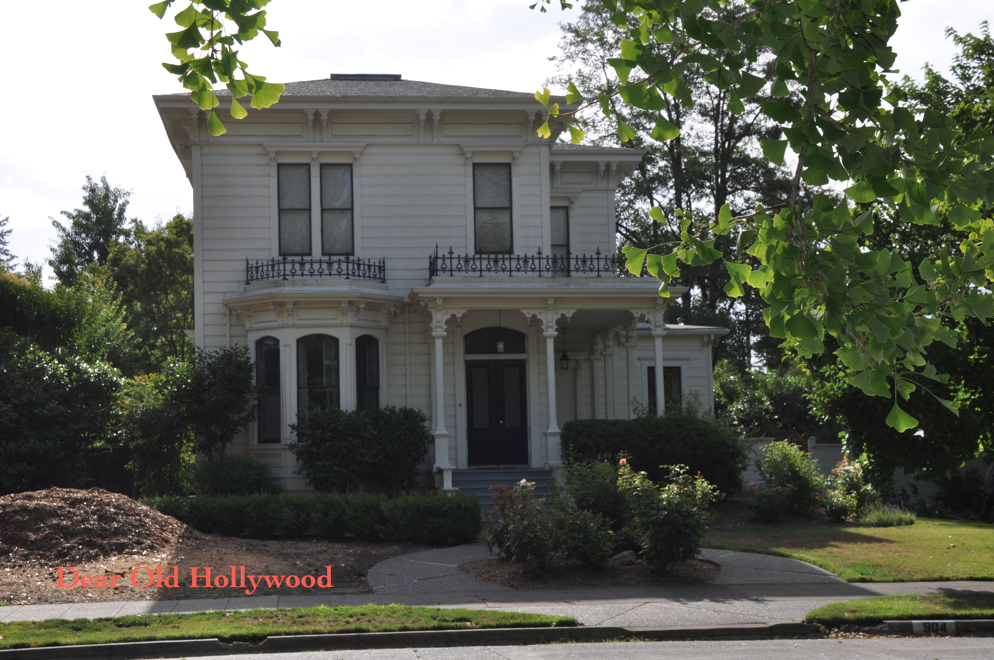
904 McDonald Avenue. Shadow of Doubt (1943)

904 McDonald Avenue as it appears as of July 2013.

It's been well documented that the home Hitchcock used for Shadow of a Doubt was a house located at 904 McDonald Ave. It is at this home that Uncle Charlie (Joseph Cotten) visits his sister's family when he needs to hide out from the police. The film stars Teresa Wright, Macdonald Carey, Henry Travers, Patricia Collinge, and Hume Cronyn. Other than some landscaping changes, the exterior of the home looks very much the same. 

Teresa Wright and Joseph Cotten on the steps of 904 McDonald Ave.

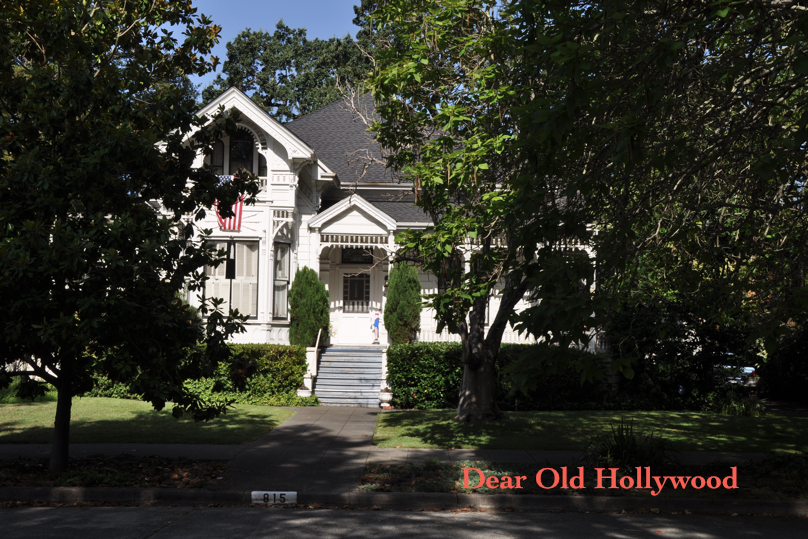
Across the street from the house used by Hitchcock is the home used in the made for television remake of Shadow of Doubt (1991), located at 815 McDonald Avenue. The remake starred Mark Harmon and Margaret Welsh in the lead roles and Hitchcock star Tippi Hedren had a part as Mrs. Mathewson.

Shadow of a Doubt (1991) house. 815 McDonald Avenue.

One house south from Hitchcock's Shadow of Doubt home is a house used in the Wes Craven thriller, Scream (1996). The house located at 824 McDonald Avenue was the home of Rose McGowan's character, Tatum. In the screenshot below McGowan can be seen talking with Neve Campbell on the home's porch. According to a San Francisco Chronicle article from 2002, Hitchcock would sit on the same porch at 824 McDonald Avenue and have cocktails with then owner, Judge Donald Geary. Judge Geary's son Bill, who was 13 when Hitchcock came to town for Shadow of a Doubt, said, "He [Hitchcock] used to come over and visit and have a drink with my dad. But Joseph Cotten was a kind of a stuffy guy. He'd have people come light cigarettes for him."

Rose McGowan and Neve Campbell in Scream (1996).

824 McDonald Avenue. Home used in Scream (1996), All My Sons (1948), and where Hitchcock had cocktails with Judge Geary between filming Shadow of a Doubt.

Campbell and McGowan on the porch at 824 McDonald Ave.

Burt Lancaster and Louisa Horton in All My Sons (1948). 824 McDonald Ave in background.

Another film that was made on McDonald Avenue is All My Sons (1948) starring Edward G. Robinson, Burt Lancaster, Mady Christians, Louisa Horton, and Howard Duff. The film also includes a young Harry Morgan (famous later for his role in the television show M*A*S*H) who I will bring up again later in this post. IMDB.com and other sources mention that a home was filmed on McDonald Avenue but no source I found mentioned which home. 

Using screenshots as reference while walking down McDonald Avenue, I discovered three homes that can be clearly seen in the film. The first home is the house at 824 McDonald Ave. See the screenshot above with Lancaster and Horton. Yes, this is the same house from Scream and that porch is the one that Hitchcock sat at while having cocktails with Judge Geary while filming Shadow of a Doubt.

825 McDonald Ave. All My Sons (1948).

825 McDonald Ave. as it appears July 2013.

The second home that can be seen in All My Sons is the house located at 825 McDonald Ave. See the comparison above and the screenshot with Edward G. Robinson below.

Edward G. Robinson in All My Sons. 825 McDonald Ave.

The third home that can be seen in All My Sons is the home located at 815 McDonald Ave. See the comparison below.

Horton and Lancaster in front of 815 McDonald Ave.

815 McDonald Ave. home used in All My Sons (1948).

815 McDonald Ave. as seen in All My Sons (1948).

The most prestigious home on McDonald Avenue is the McDonald Mansion (a.k.a. Mableton Mansion) that was built in 1877 as a summer home for the McDonald Family. This beautiful mansion located at 1015 McDonald Avenue was used as Aunt Polly's house in Disney's Pollyanna (1960). The film stars Hayley Mills, Jane Wyman, Agnes Moorehead, Adolphe Menjou, Richard Egan, Karl Malden, Kevin Corcoran, Nancy Olson, and James Drury. One thing noticeable right away is that the home used in the film is much taller than the actual house. This is because Disney artists used a matte painting to create the illusion that there were two additional floors. See a comparison of the Pollyanna house below.


Mansion from Disney's Pollyanna (1960).

The McDonald Mansion used for Pollyanna. 1015 McDonald Ave.

Me and my little Pollyanna at the gate of the McDonald Mansion.

This last film location is my personal favorite. It's from a little known film called Happy Land (1943) starring Don Ameche, Frances Dee and Harry Carey. The cast also includes Ann Rutherford, Dickie Moore, a young Harry Morgan and Natalie Wood in her film debut.

IMDB.com and other sources mention that this film was shot in Santa Rosa, but nowhere could I find where any scenes were filmed, not even any streets. I figured if Hitchcock, Disney, and others all made films on McDonald Avenue that maybe there was a good chance that Happy Land was also filmed on McDonald Ave. Fortunately, my instinct was correct! Before I visited McDonald Avenue, I had used Google Street View to look up and down the street to see if I could find a home that matched the below screenshot. The home of Don Ameche's and Frances Dee's characters is located at 1127 McDonald Ave. I've also found many of the other film locations used in Happy Land that have not been reported anywhere which I will include in a larger post on this movie later.

Don Ameche and Harry Carey in Happy Land (1943)

1127 McDonald Ave. Home used in Happy Land (1943).

A couple interesting facts:
  • Both Hitchcock's Shadow of a Doubt and the Don Ameche film Happy Land were filmed in 1943 within a couple blocks of each other on McDonald Avenue. 
  • In 1943 actor Harry Morgan was in the film Happy Land and then in 1948 he appeared in the film All My Sons which both filmed on McDonald Avenue.
  • Joseph Cotten was originally considered for Happy Land, but instead appeared in that other 1943 film, Shadow of a Doubt.
Wifey and Hazel admire the flowers on McDonald Avenue.

Santa Rosa's McDonald Avenue is a beautiful residential street with gorgeous homes. Even if it were not for all the film related connections, this street would be a nice place to go for a stroll. The film history just makes it that much more fun for movie lovers.

Check back the next couple weeks for more highlights from our Fourth of July weekend trip.
Older Post ►
eXTReMe Tracker
 

Copyright 2011 hollywood classic is proudly powered by blogger.com