Showing posts with label Myrna Loy. Show all posts

The Colonial House - A Classic Hollywood Apartment

The Colonial House. Photo: TopLACondos.com

Built in 1930 and designed by noted Los Angeles architect Leland Bryant (Harper House, Savoy Plaza, Sunset Tower), the Colonial House has long been a home to celebrities. According to The Movieland Directory, some early Hollywood residents have included Clark Gable, Carol Lombard, Myrna Loy, Eddie Cantor, William Powell, and Norma Talmadge. Cary Grant, Bette Davis and Joan Blondell have also called the place home. Earlier this year even pop singer Katie Perry purchased a place in the Colonial House, continuing the building's legacy for being a home for stars.

Listed in the National Register of Historic Places, the property features wrought-iron fixtures, gardens, a swimming pool, library, arched doorways, custom built-in cabinetry, wood-paneled elevators, a terrace and includes views of the mountains and Hollywood. The elegant Colonial House is conveniently located near the nightclubs on the Sunset Strip, is just a short drive to the premium shopping in Beverly Hills, and central to the many movie studios in the area. It's no wonder why so many stars have chosen the Colonial House as their home. 

No doubt a place like the Colonial House must have many great stories.  A couple stories I'm familiar with involve actresses Joan Blondell and Bette Davis.

Joan Blondell & Bette Davis. Colonial House residents.

In 1960, Joan Blondell, who was 54 at the time, left her Sutton Place apartment in New York City and moved back to California, finding an apartment in the seven-story Colonial House. Most of her family were in California, including her grandkids and many of her close friends. One of her longtime friends, former neighbor Frances Marion already lived in the Colonial House and the two would reunite their close friendship. Joan and Frances would catch up every afternoon at five over cocktails with some of the other female tenants which included newspaper columnist Jill Jackson, publicist Maggie Ettinger, and stockbroker Flora Marks. 

Entrance to the Colonial House. TopLACondos.com

Not long after Joan moved in she found herself busy with work on television, first as a rich widow on an episode of The Untouchables and then as a psychopath on the Barbara Stanwyck Show - both filmed at Desilu Studios in Culver City. Joan was also still working in movies too and when she would have to go out of town for location filming, her neighbor Jill Jackson would feed and walk her dogs, Bridey and Fresh. In his biography, Joan Blondell: A Life Between Takes, author Matthew Kennedy retells this story told by Jackson:
"Her life was those two ugly dogs!" said Jackson. To her consternation, "those damn dogs" only agreed to evacuate their bowels on the lawn of the nearby Christian Science church.

Bette Davis's former Colonial House living room as it appeared in 2012 when the unit was up for sale. (Gordon Thompson)

Bette Davis had many places around Los Angeles she called home at different points in her life. The Colonial House would be the last home she would live in. In the late 70s, according to the Roy Moseley memoir Bette Davis, the actor Roddy McDowall helped find her a place in Colonial House. Davis liked the apartment because it overlooked the La Ronda apartment house, where Bette and her mother first stayed when they arrived in California from New York. Bette wasn't a movie star then, but just a young woman ready for her big break.

Bette's apartment was on the fourth-floor and had large spacious rooms with twelve-foot high ceilings. She decorated the place with framed pictures nailed to the walls and with art books and family photographs on the tables. On the floor, on each side of a lattice doorway that led to the dining room, Bette placed her two Oscars which she won for Best Actress: one for Dangerous (1935) and another for Jezebel (1938).


Moseley, who was very close to Bette in her later years, shares this story of one of his visits to Bette at the Colonial House:
"From her balcony you could see down to the swimming pool below. One day, Bette was leaning on the rail looking over at a corpulent man and his attractive family as they all swam and sunbathed. 'Look at that,' Bette shouted to me, loud enough for her voice to carry clearly down to the ground. 'Look at that disgusting man. It's revolting that a nice young girl and her children should have to be with such a fat, disgusting man.' I hoped they could not hear and tried to stop her, but she pretended not to understand what I was talking about."
Yikes! I picture dialogue like that coming out of Bette's character Jane Hudson, from the film Whatever Happened to Baby Jane? (1962). Much like Joan, Moseley mentions that Bette also enjoyed a good cocktail hour. Perhaps her tongue was loosened by liquor.

Pool area. TopLACondos.com

The Colonial House, like Leland Bryant's other West Hollywood apartment building, the Harper House, has also appeared on screen as a filming location. In the Broderick Crawford crime film, Down Three Dark Streets (1954), the Colonial House appears in a scene where Crawford and his FBI partner go to interview one of the residents as part of a crime investigation.

Broderick Crawford in the film Down Three Dark Streets (1954).

If you're now interested in moving into the Colonial House, you're in luck! There is a one bedroom unit on the first floor that is available for $1,275,000. For more information and photos on this unit visit the real estate listing here.

The Best Years of Our Lives (1946) - Film Locations

Theatrical Poster

There are so many movies about war, but not nearly as many that show life after war. One of the few classics on the post-war subject is the 1946 film, The Best Years of Our Lives. This Academy Award winning film tells the story of three veterans returning home from World War II and the challenges each one faces. 

Fredric March plays Al Stephenson, an Army Sergeant who returns to his loving wife Milly (Myrna Loy) and their family. He was a successful bank executive before the war and when Al returns, he is promoted to Vice President. All seems good, except that Al is having trouble adapting back to civilian life and is now struggling with alcoholism. 

Dana Andrews plays good looking Fred Derry, a soda jerk before the war and during the war an Air Force bombardier. After the war, Fred expects to get a better job upon returning home, but finds that he faces tough competition from other returning vets and that he lacks the necessary civilian skills. To make matters worse, Fred's wife has moved on to other men while Fred was away at war. 

Harold Russell plays Homer Parrish, the quarterback of his football team before the war, who married his sweetheart Wilma (Cathy O'Donnell) before leaving to fight. Homer, a sailor in the war, lost both of his hands. When he returns home to his fiance and family, he has trouble adjusting to life with his disability. What troubles Homer most of all is that he feels that he will be a burden on his fiance, so he pushes her away, trying to give her a way out of their relationship. 

The home that Fredric March's character returns to is an apartment building located at the corner of Beverly Boulevard and N. Sycamore Avenue in Los Angeles. It's a pretty nice building about a block from La Brea Avenue that looks like the kind of fancy place where a bank executive might live. Below is a screenshot of the building from the film and an image of the building as it appears today.

Fredric March's apartment building.

Fredric March's apartment on Beverly Blvd (c) 2013 Google

Looking east down Beverly Blvd.

Looking east down Beverly Blvd (c) 2013 Google

Fredric March returns home with Dana Andrews in the car.

The Best Years of Our Lives won seven Academy Awards, including Best Motion Picture, Best Director for William Wyler, and a Best Actor award for Fredric March. This film is currently available on DVD and it sounds like a blu-ray release is still TBA.

Ralph Bellamy Arrives in Hollywood, Has Dinner With Clark Gable

Ralph Bellamy

Once sound made its way into films many silent film stars soon found themselves out of work. Some silent stars didn't have voices that fit their on-screen image. Others were foreign actors who suddenly needed to be able to speak English, which wasn't an issue for silent films. For many silent actors though, they just didn't possess the ability to memorize and speak lines. The Hollywood studios quickly turned to Broadway in order to find trained actors that could meet the needs of the new talking pictures. This is the era that actor Ralph Bellamy entered Hollywood.

Prior to films, Bellamy had been honing his acting skills on the stage, first in stock theatre and eventually Broadway. Just before Bellamy moved to Hollywood he was cast as the part of Texas in the play Roadside, which ran at the Longacre Theatre in New York. What Bellamy thought was going to be a big hit ended up closing after just eleven performances. Fortunately, for Bellamy, he was getting contract offers from a few major movie studios. Bellamy signed with United Artists, headed by Joseph Schenck, and like so many actors during this time, left the stage for the screen.


The Knickerbocker Hotel

Bellamy took a first class train from New York to Los Angeles. When he arrived in Los Angeles he moved into the Knickerbocker Hotel located at 1714 Ivar Avenue in Hollywood. The hotel, which is now senior apartments, used to be a choice hotel for many newly arrived actors. 

It was November when Bellamy arrived in Hollywood and the city was dressed for Christmas. The city was having a Christmas parade. A truck pulling a large propeller rolled down Hollywood Boulevard in which a man threw confetti that then blew like snow over the spectators. This was followed by Santa Clause in his sleigh, musicians in folk costumes and various other parade vehicles. It was a hot November, especially for an actor who just came from New York.


Henry's Restaurant (Photo from Getty Images)

Former site of Henry's Restaurant

Rather than going to work right away for United Artists, Schenck loaned out his newly acquired star to Irving Thalberg over at M-G-M. Thalberg, in December 1930, put Bellamy to work in the film The Secret Six, which also starred Wallace Beery, Jean Harlow, and Clark Gable. Bellamy played "Johnny Franks," a bootlegger/cafe owner.

One night during the filming of The Secret Six, Bellamy went and had dinner at Henry's Restaurant in Hollywood. Henry's was financed by Charlie Chaplin and operated by fellow silent film actor, Henry Bergman. According to the book, The Story of Hollywood, by Gregory Paul Williams, Henry's was the first restaurant in Hollywood to stay open after midnight. It was Al Jolson's favorite spot to eat after the fights at Legion Stadium and was a favorite spot of actress Myrna Loy, as well as many other Hollywood celebrities of the time.

Clark Gable

While at Henry's, Bellamy's co-star Gable came into the restaurant and sat next to him. After Gable ordered his meal, Bellamy, in his autobiography, When the Smoke Hit the Fan, says their exchange went like this:
"What do you think of all this out here?" [asked Gable]
"I don't know yet," I answered. "I haven't been here long enough to form an opinion."
"I just got eleven thousand dollars for playing a heavy in a Bill Boyd Western," he exclaimed. "Eleven thousand dollars!" he went on, almost in disbelief. "No actor's worth that. This can't last. I've got myself a room at the Castle Argyle [an inexpensive hostelry at the top of Vine Street] and a secondhand Ford. I'm socking away everything I can and I'm not buying anything I can't put on The Chief. This just can't last."
While Gable's thinking was wise, his fears never did come true. Both Bellamy and Gable went onto have successful careers until the end of their lives.

Belles on Their Toes (1952) - Film Locations

Belles on Their Toes (1952)

In less than two months, Santa Monica High School seniors will be participating in their graduation ceremony at the Memorial Greek Amphitheatre located on the campus. This is the same theatre in which Myrna Loy, in the film Belles on Their Toes (1952), joyously watched her youngest daughter's graduation ceremony. Although there have been some dramatic changes to the theatre during the last 61 years since the film was made, the Memorial Greek Amphitheatre is still very recognizable.

Belles on Their Toes is the sequel to the original Cheaper By the Dozen. In Belles, Loy, the mother of twelve children, continues to look after her family, but now without the help of her husband who had passed away at the end of the first film. You would expect the film to focus on Loy and the difficulties of a single woman raising twelve kids, but instead the film is centered more on the teenage romances of the older daughters. The film begins with Loy, done up in makeup to appear older, attending the graduation ceremony of her last child and then the story jumps back in time to show events preceding the graduation.

Note: Click images to see larger.

Graduates walk the steps of the Memorial Greek Amphitheatre at Santa Monica High School in the film Belles on Their Toes.

A contemporary view of the Memorial Greek Amphitheatre at Santa Monica High School. Photo from Santa Monica-Malibu Unified School District.

Memorial Greek Amphitheatre as it appears in Belles on Their Toes.

The outdoor Greek style amphitheatre was originally built in 1921 to honor Santa Monicans that had served in World War I. Plaques on the walls of the amphitheatre listed all of the Santa Monicans that had served in the war. In the 1950s, a second level was added to the Greek, which you will notice by looking at the comparison of the screenshot and contemporary images below. Other additions to the theatre since it first opened in 1921 include plaques honoring Santa Monicans who have served in every major military conflict, as well as one for a student who was killed because of gang violence in the early 2000s. The Memorial Greek Amphitheatre first hosted a graduation ceremony in 1921 and has every year since.

The Memorial Greek Amphitheatre in Belles on Their Toes.

Contemporary view of the Memorial Greek Amphitheatre in Santa Monica.

Myrna Loy on the steps of the Santa Monica High School Memorial Greek Amphitheatre as seen in Belles on Their Toes.

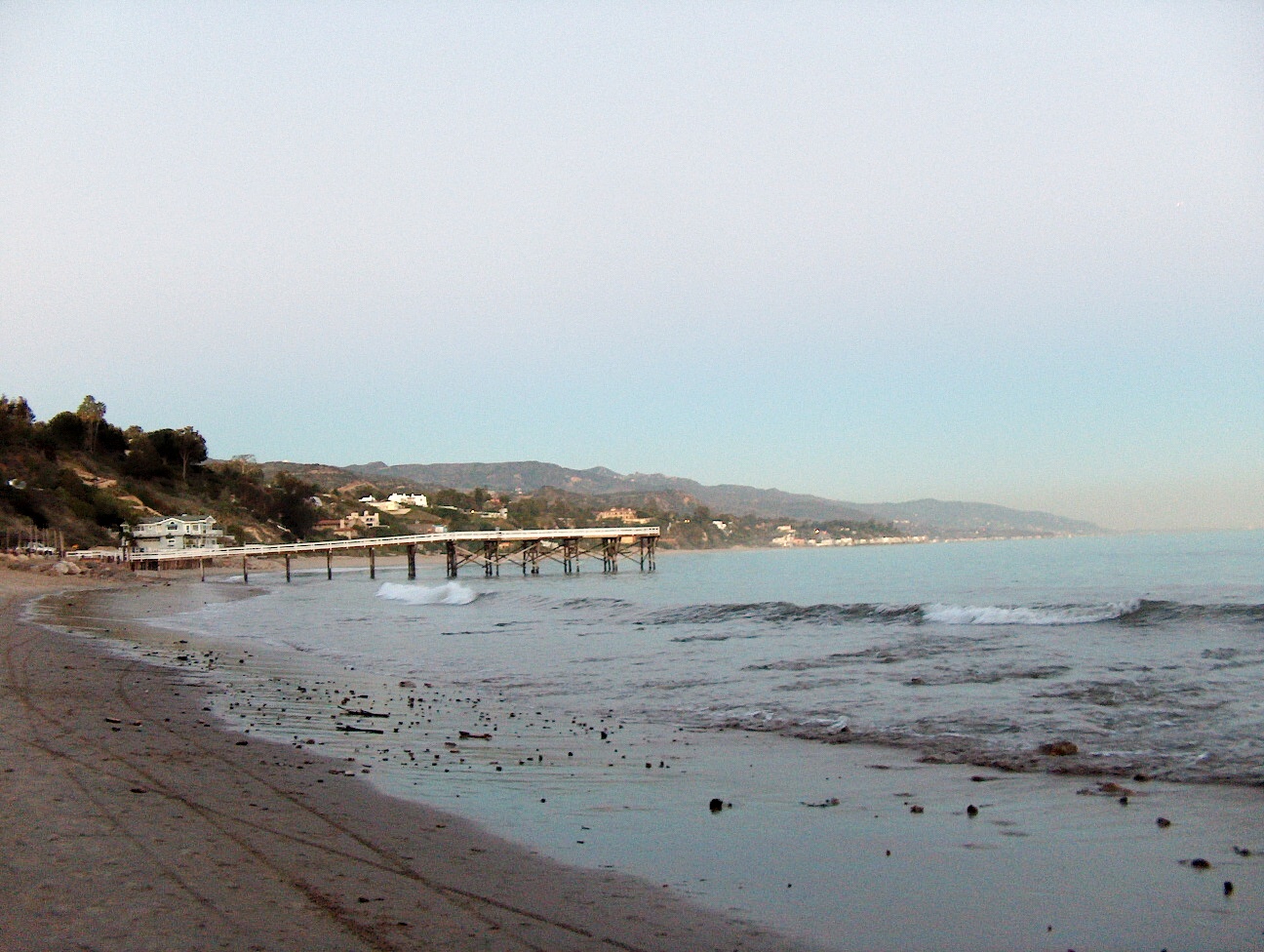
Most of the scenes in the film were shot on the 20th Century Fox Studios lot, with the exception of the graduation scene which was filmed on location at Santa Monica High School, and another scene that was filmed on location at Paradise Cove in Malibu. In the scene below the kids spend a day at the beach and two of the teenage daughters try flirting with the local boys. Minus the vintage bathing suits and umbrellas, this stretch of coastline is pretty much the same quiet beach area.

Paradise Cove, Malibu, Ca as seen in Belles on Their Toes.

Paradise Cove Pier, Malibu, Ca. Photo: Wikimedia.org

Don't you just love those bathing suits?


Paradise Cove, Malibu as seen in Belles on Their Toes.

Photo from LA Observed. Paradise Cove Pier

In addition to Myrna Loy, the Belles on Their Toes cast includes Jeanne Crain, Debra Paget, Jeffrey Hunter, Edward Arnold, Hoagy Carmichael, and Verna Felton who voiced many Disney characters. Belles on Their Toes was directed by Henry Levin. The film is available on DVD and can also be rented through ClassicFlix.

Love Crazy (1941) - Film Locations


Steve and Susan Ireland are about to celebrate their fourth anniversary, but when Steve runs into an old flame, a meddling mother in-law convinces her daughter that Steve is cheating on her. After some misunderstandings Susan decides to file for divorce. Steve pretends to be crazy in order to delay the divorce and buy some time to win his wife back. That's the premise for the 1941 screwball comedy Love Crazy. 

William Powell and Myrna Loy, famous as a husband and wife team in the Thin Man films, once again play husband and wife in Love Crazy. Although this comedy is a fun watch, it doesn't have the same wit as the Thin Man films and at times the humor seems forced. The best moments come from the supporting cast, particularly Jack Carson, a neighbor who gets in the middle of the Ireland's marriage and Florence Bates who plays the mother in-law.

Most of the action takes place inside the Ireland's apartment building, but of the few exterior scenes, I recognized some sets from the MGM backlot. I was later able to verify the MGM backlot sets using the book, M-G-M: Hollywood's Greatest Backlot, by Steven Bingen, Stephen X. Sylvester, and Michael Troyan. This book makes a great reference book.

William Powell gets pushed into the "Esther Williams Pool"

In one scene, Powell, who is attending a party, takes all of the mens' hats from the hat check and throws them into a swimming pool. Powell is pretending to be crazy by "emancipating" the hats. In the process Powell gets shoved into the "Esther Williams Pool." According to M-G-M: Hollywood's Greatest Backlot, the pool was built in about 1935. Williams didn't take her first swim in the pool until 1942 but she would go on to use the pool frequently for her many aquatic themed pictures.

Powell is taken into the Dr. Wuthering's Rest Home

After a judge believes Powell to be crazy, he is sent to the Dr. Wuthering's Rest Home, which was really the MGM "Girl's School" backlot set. This set was possibly first constructed for the 1940 film, Forty Little Mothers. Some other movies that have used the Girl's School set included Cynthia (1947) The Cobweb (1955), and The Wheeler Dealers (1963).

Below is a video tour of the MGM backlot showing how some of the outdoor sets appeared in 1963. One of the backlot sets that is seen in the video is the Girl's School set, starting at the 33 second mark.

MGM Studios backlot video tour.

Powell on the Girl's School backlot set.

Jack Carson and William Powell on the Girl's School set.

Unfortunately, these MGM backlot sets have been demolished so the only way we can see them now is in these classic movies.

Love Crazy is available for rent through ClassicFlix and is also available to purchase on DVD.

To learn more about the book M-G-M: Hollywood's Greatest Backlot, visit the official site here. You can also read my interview with one of the coauthors, Steve Bingen, here.

Hollywood's Earl Carroll Theatre

Earl Carroll Theatre, 6230 Sunset Blvd

In 1938, after getting his start in New York, Earl Carroll would move his dinner theatre business to Sunset Boulevard in Hollywood, California. A show at the Earl Carroll Theatre, according to an early advertisement, included a chance to dance to "two famous orchestras, watch a CBS broadcast, and dine on superb dishes created by world-renowned chefs." For $3.50 you could enjoy all of the evening's entertainment plus a full-course dinner or for $1.65 without dinner.

Another advertisement exclaims the theatre features "sixty of the most beautiful girls in the world." These girls would perform elaborate stage revues usually led by a popular star.

During the 1940s, Hollywood was the nightspot destination for visiting servicemen. Like the Hollywood Canteen or the Florentine Gardens, the Earl Carroll Theatre welcomed many servicemen. You can imagine at the price of $3.50 you got more bang for your buck than you would have visiting some of the Sunset Strip nightclubs.

The Earl Carroll Theatre would continue to be a popular nightspot until June 17, 1948, when Carroll died in a plane crash. Afterwards the club would struggle for a few years. In 1953, Frank Sennes changed the club into the "Moulin Rouge." Still a theatre and restaurant, the Moulin Rouge featured more Vegas Style shows and would last into the 1960s.

6320 Sunset Blvd, Hollywood, Ca

Above is an image of the Earl Carroll Theatre building as it appears today. The building is now occupied by Nickelodeon studios.

"Wall of Fame" Earl Carroll Theatre

Grauman's Chinese Theatre had celebrity hand prints, footprints and signatures in the sidewalk in front of the theatre. The Earl Carroll Theatre had celebrity signatures on plaques on their "Wall of Fame" next to the entrance of the theatre. Some of the names on the plaques include Don Ameche, Rosalind Russell, Joan Bennett, Ray Milland, and Myrna Loy. Does anyone know where these plaques are today?

Beryl Wallace

One of the stars of the Earl Carroll Theatre shows was the beautiful Beryl Wallace who also happened to be Earl Carroll's wife. Wallace also died in the same plane crash as her husband.

Earl Carroll Theatre Glasses

If you went to the Earl Carroll Theatre one of the souvenirs you could purchase was a set of "Hollywood Star Autograph Glasses." The set included eight different glasses with color embossed autographs of many of the popular actors and actresses of the time. The colors came in Red, Blue, Green, Orange, White, Maroon, Yellow and Black and each color had different celebrity signatures. Fred Astaire was on the green set, Humphrey Bogart on the orange, and Rita Hayworth on the red set for example. To purchase a set of these eight glasses would put you back $3.00. Does anyone still have a set of these glasses in their home? If you do, I hope they're on display and not being used!

Frank Sennes Moulin Rouge on Sunset Blvd

Above is an image of Frank Sennes Moulin Rouge. As you can see, the Wall of Fame is still on display outside the theatre. From the outside, the building did not change much from the change over from being the Earl Carroll Theatre to the Moulin Rouge, other than the signage. You can still go by the theatre today but now you will see all the Nickelodeon signage displayed on the building - and no Wall of Fame.

As I mentioned before, I always like reading the messages on the back of old postcards. On the backside of the very first Earl Carroll Theatre postcard displayed at the top of this post it reads, "We are about ready to start our long trip back - this place is pretty but we haven't seen any movie stars." Postmarked in 1947 to a Mrs. Rose Kellerman & Sister in Memphis, Tenn. Even back then tourists were disappointed to not have any star sightings.
Older Post ►
eXTReMe Tracker
 

Copyright 2011 hollywood classic is proudly powered by blogger.com